
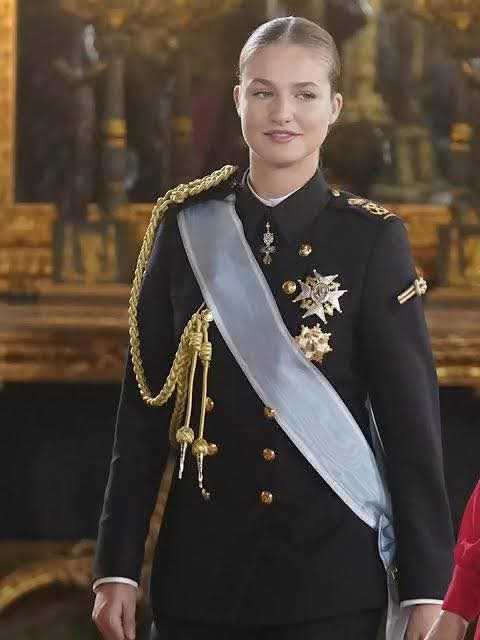
Leonor de Borbón y Ortiz, Princess of Asturias, is being prepared to one day take the throne in a succession long dominated by men since the era of Queen Isabella II in the nineteenth century. Her birth marked a significant turning point in Spain’s royal history, and her upbringing has been carefully structured to mold a future head of state capable of meeting the political, social, and diplomatic demands of the twenty-first century.
Her position as heir was established early in life, despite Spain still maintaining succession laws that give preference to male heirs. As King Felipe VI and Queen Letizia have no son, Leonor has remained first in line to the throne. Her training goes far beyond academic study; it involves direct engagement with constitutional principles and a lifelong awareness of the public responsibility she is destined to assume.
In order to expand her intellectual and cultural perspective, the Princess studied at the renowned UWC Atlantic College in Wales. Removed from the formal routines of the Zarzuela Palace, she lived and learned alongside students from diverse countries and social backgrounds. There, she completed the International Baccalaureate in an environment that prioritizes global citizenship, community involvement, and peaceful conflict resolution—skills essential for future leadership on the international stage.
A crucial component of her development is the mandatory training within Spain’s armed forces academies, a long-standing requirement for future monarchs. Leonor embarked on a rigorous three-year program designed to immerse her in the discipline, structure, and responsibilities of the nation’s security institutions. This experience is far from ceremonial; she resides in military barracks, performs the same duties as her peers, and is held to identical physical and mental standards, without special treatment.
Her military education began at the General Military Academy in Zaragoza, where she focused on ground-based instruction. There, she trained in topography, survival techniques, and leadership skills. Public images of her in uniform—enduring physically demanding drills and navigating rugged terrain—captured national attention, revealing a resilient and disciplined side that contrasts sharply with her poised appearances at official state events.
Subsequent stages of her preparation include naval training at the Naval School in Marín and air force instruction at San Javier. A defining element of this phase is her time aboard the training ship Juan Sebastián de Elcano. The months-long voyage serves as a demanding test of endurance, cooperation, and resilience, as the future queen learns astronomical navigation and adapts to life in the confined quarters of a historic sailing vessel alongside fellow cadets.
A major milestone in her public life occurred when she reached the age of 18 and formally swore loyalty to the Spanish Constitution before Parliament. This solemn ceremony granted her full constitutional legitimacy to succeed to the throne and, if required, to immediately carry out the duties of head of state. Broadcast to millions, the event symbolized her transition into adulthood and her formal commitment to national service.
Her growing popularity—often referred to by the media as “Leonormania”—reflects her image as a symbol of renewal. Many see her as a vital link between Spain’s traditional monarchy and Generation Z. Known for her reserved demeanor, seriousness, and confident communication skills, she has already delivered speeches in Spanish, Catalan, and English at the Princess of Asturias Awards ceremonies.
Outside the public spotlight, little is revealed about her private life, as the royal household carefully guards her personal space. Nevertheless, it is known that she has a strong passion for music, having played the cello since childhood, along with a keen interest in cinema and literature. These cultural pursuits enrich the profile of a modern leader who recognizes the role of the arts in shaping national identity.
Leonor stands as the embodiment of the Spanish monarchy’s future in a rapidly evolving world. Her role will be to safeguard the nation’s unity and stability—responsibilities she is steadily learning to shoulder. Supported by a strong academic foundation and hands-on military experience, she is widely regarded as one of Europe’s most thoroughly prepared heirs, poised to usher in a new chapter in her family’s centuries-old legacy.